
I have always felt strangely disjointed while living in the Valley. With both of my parents from the Dominican Republic, being a first-generation American and living in the Rio Grande Valley created a singular yet slightly fragmented way of growing up. Dominican customs and traditions and American ideals intersected among the heavily-influential Mexican culture in the Valley. Even after living in the Valley for over 18 years and being active within our own Dominican community here, it’s an intimidating and overwhelming feeling when you know you’re on the same Latinx wavelength as the people around you, but there’s still a hiccup in your Valley identity because of your similar yet inherently different customs.
I had never been able to truly verbalize this discomfort or pinpoint where it stemmed from, but I knew this feeling of un-belonging to my own community is where my desire to leave Texas came from. As a child, I wanted to become an illustrious pastry chef and study in New York, working towards the ultimate goal of becoming a Food Network star. I had never felt tied down to my hometown with the exception of family, friends, and my pets, and figured I’d have nothing to lose if I left. Though times have changed and though my career interests don’t exactly line-up with my eight-year-old self anymore, I’m still fulfilling my childhood dream of attending school outside of Texas; I’ll be studying Journalism at Northwestern University in Illinois beginning this fall. However, I’m finding it harder than I ever could have expected to say goodbye.
At the beginning of this final summer (because for all intents and purposes, this is my final summer as an official resident of the Rio Grande Valley), I became involved with an internship with the wonderful people at Curando RGV, which describes itself as “an intersectional community organization empowering our people in a variety of ways through activism, the arts, local history, and culture.” I had grown involved with the social justice scene in the Valley, but wanted to find a way to make more of an impact and figured this internship would steer me in the right direction.
Though I selectively chose to involve myself in the Media and Reproductive Justice committees, the internship proved that I would be working in all aspects to help improve the Valley; I’ve been volunteering as a clinic escort at Whole Woman’s Health in downtown McAllen throughout the summer, and as a whole we’ve volunteered at the McAllen Nature Center, visited ARISE in Alamo and saw the powerful and important work they are doing to help low-income immigrant families, and helped collect clothing for Curando RGV’s donation drive for the Refugee Center at Sacred Heart Church. I’ve experienced the Valley in such an incredible way. However, I never thought that the social justice work we were doing would intersect with the one thing I admittedly love most: music.
I witnessed the power and influence that comes from the intersection of music and social justice at Galax Z Fair — a two-day festival put on by Tigersblood.org that takes place during Spring Break — where the festival and a demonstration involving the Caravana 43 coincided. Galax Z Fair became a space for the family of those disappeared 43 students to speak to an audience of mostly high school and college-age individuals and to alert and educate them on the heinous situation they were enduring and what we could do as a community to get closer to the justice that their loved ones deserve.
“A border culture is a beautiful culture, and I wish more of us here, as well as other alternative media outlets, realized this.” – Patrick Garcia
At the beginning of the summer, word began flying around that a new, two-day summer music festival was in the works for McAllen. AQUÍnceañera was to be a totally unique festival; a celebration of place and independent sound complete with a brand-new venue devoted to culture, creativity, and inclusion. In my case, the initial announcement of the festival didn’t relay its immediate importance. Of course I was excited that there was another festival happening quite literally in my own backyard, but I was expecting something along the lines of Galax Z Fair.
However, AQUÍnceañera strayed far from any and all music festivals I’d attended in the past. AQUÍnceañera was an entity of its own, incomparable and immeasurable in importance to the countless other summer music festivals happening. There may be words in existence to describe what occurred AQUÍnceañera, but I don’t believe there exist words to describe how being at AQUÍnceañera felt.

“In the Valley, nearly everyone is a person of color. And if one throws a local fest, I mean, that’s ultimately what it’s going to be. But the idea of celebrating that element, as well as place, is a narrative I wanted to see revived, reminded, and asserted.” – Patrick Garcia
Walking into Yerberia Cultura for the first time was like walking into a friend’s backyard; it felt like home. Though I attended the first day of the festival alone, I didn’t feel alone in the slightest. I saw the familiar faces of those active in the local music/activist scene, I saw some well-known friends, but the electricity in the air of finally having a safe and familiar venue was intoxicating and enough to make being alone completely comfortable. Throughout the evening, which was filled with dancing to Selena out on the patio and complete with a Donald Trump piñata, I went around asking friends at AQUÍnceañera their thoughts on the festival, which allowed me to see that it wasn’t just me surging with feelings of love and community those two nights.
“It’s important because it’s really easy to lose your culture. […] Here, it’s everywhere. It’s expressed in all the art being made. You’re with your own people and your own culture.” – Myriah Acosta
“I think it’s important because you are celebrating what you are. I feel like in the Valley we always try to be ‘we want to be like Austin’ or ‘we want to be like San Antonio’, and this is a counter to that. We don’t need to be that; we are something different. In my opinion better, but it’s definitely different, and I think it’s beautiful. There’s nothing like this.” – Edgar Gonzalez
From Danica Salazar’s throaty pleas of “DON’T FORGET YOUR PLACE” during DeZorah’s final song to Victoria Ruiz’s constant affirmations of love for McAllen and the Rio Grande Valley throughout both Downtown Boys’ set and the days preceding the festival via social media, it was obvious that AQUÍnceañera stood for something far and beyond the music.
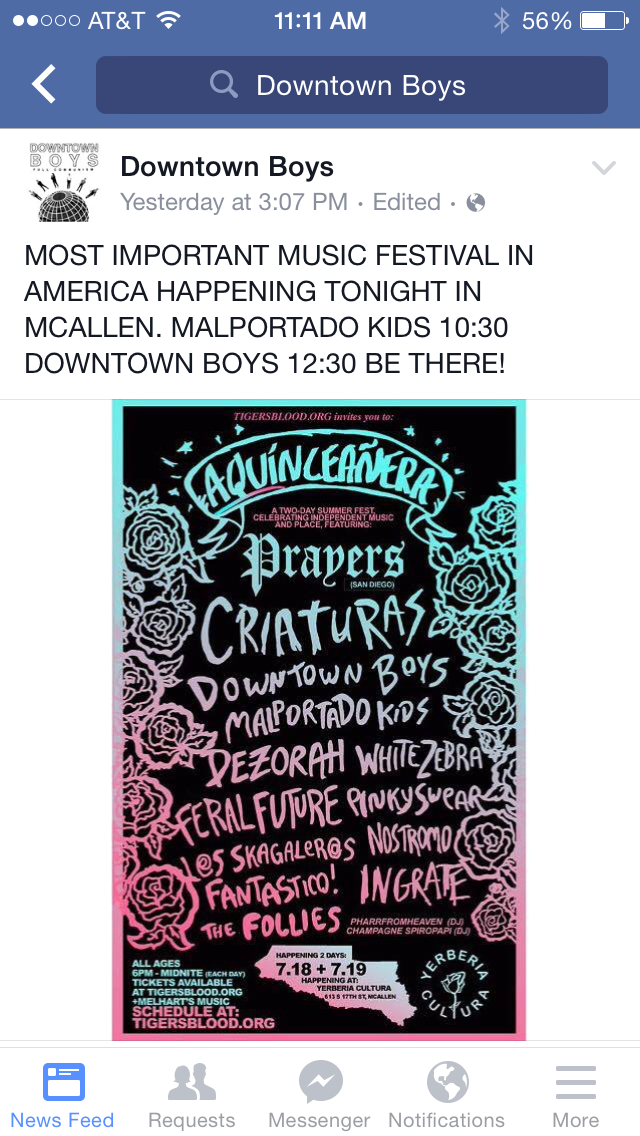
The festival did not occur in a vacuum in which music and social issues were mutually exclusive and where we would all return to our daily lives and recount the weekend’s events as just another concert. It became a space where important issues, such as the brutalization of black and brown bodies at the hands of police, feminism, immigration justice and reform, and the the Valley’s first-ever conference for queer people of color, were openly and publicly discussed within and alongside the music and persisted within the festivalgoers. Before Malportado Kids exited the stage band member Joey DeFrancesco said, “We’ve been all over the country this month and this is the most special thing we get to do.” In those moments was impossible to acknowledge the beauty and singularity of the place where we live.
I left the venue that night feeling warm and starry-eyed, and that warmth continued onwards into Aquí Estamos, the Rio Grande Valley’s first-ever conference focusing solely on LGBT people of color and the intersections that those identities bring about in the RGV. Full of insightful workshops, knowledge-sharing activities, and beautiful and positive individuals committed to making the Rio Grande Valley a safe and equal space for lesbian, gay, bisexual, transgender, and queer-identifying people of color, Aquí Estamos was a learning experience and a chance to communicate with individuals who we may not necessarily see or hear about in our every day lives. Taking part in such a critical and pivotal movement was a reality check in the practices of what allies like myself should be doing in order to bolster the voices of these individuals and what we as a community must do in order to continue being an equal and safe space for everyone in the Rio Grande Valley.
The humid South Texas air blew slowly and quietly as Romeo Santos’ voice echoed throughout the patio of Yerberia Cultura. The venue was celebrating its opening eve by hosting the after-conference dance party for Aquí Estamos. As I stood in the circle of dancers, swaying my hips and spinning in time with the music, I soaked in the moment. There was a feeling of lightness, of comfort, of pure joy that I felt dancing under Yerberia Cultura’s hanging lights. I felt a connection with everyone dancing with me, even if I wasn’t necessarily the closest of friends with anyone there. The hesitation and trepidation I previously felt of not being a “true part” of my community dissolved in the night.
I realized a had a true and established home here, even when it didn’t feel like it sometimes, and realized I would miss everything about the Valley. I would miss these South Texas nights. I would miss raspas and elote and marranitos and spiropapas and conchas. I would miss the manager at my local Walgreens that sees me so often he’s started calling me “mija”. I would miss the electricity that erupts and overflows from the crowds at Cine El Rey. I would miss being a part of this community. And within the realization of everything that I would miss, that evening, I felt more present than ever. I felt powerful and whole and at home.
Me sentí AQUÍ.
 Isabella R. Soto
I felt totally related. I’m glad somebody had the courage to write about this feelings at the border. Keep the good work ! And congratulations on your new journey in Illinois.!!!
LikeLike
loved it isabella!!! Good luck on this new journey your taking!!!
LikeLike