Hi! My name's Isabella and I'm a sophomore studying journalism and Latino/a Studies at Northwestern University. This site serves as a platform to house all the writing I do, whether it be personal or from another source. Reblogs are not endorsements.
Winter is the worst fucking time for a broken heart. It’s cold. It’s miserable. No one can be bothered to go out or do anything, so you can’t take your mind off of how terrible it all feels. You’re essentially left to reckon with your redefined existence as a new and shiny Lonely Person with a negative two degree windchill howling outside your window. Not to mention that jumping into the single life as a 20-year old college student after about six years of monogamy is a terrifying endeavor by any stretch of the imagination. It seemed like all my friends were masters in casual hookups, the tendons in their thumbs well-trained from seasons of Tinder swiping and here I was, painfully benched, upset when this game that I had known so well for so long didn’t come easily to me when I was playing alone.
“Let’s give it a minute before we admit that we’re through / Guess this is the winter / Our bodies are young and blue”
And there was nothing that I loved more when I was lonely to be made to feel. There was a perverse pleasure I got in having a broken heart for the first time, in finally knowing how it felt, finally knowing what all those songs were about. I had a masochistic urge where I wanted anything and everything I consumed to hurt. I purposely listened to music that made me feel like shit, made me ache and burn. I listened to Julie Byrne and cried, I haphazardly extended Sampha’s meditations of family loss to my own loss of a relationship. I thought that if I did that enough, it could make me feel something comparable to what it was like to be in love again. I watched “Before Sunrise”. I read “This Is How You Lose Her” for the third time. I developed painful, doomed crushes on people who gave me a modicum of attention just to spite myself. I sabotaged every chance I had for myself to heal because I liked the rawness and the edge of a broken heart a little too much. And when I realized I couldn’t sustain myself off making myself feel awful any longer ( I also needed new talking points besides how much it sucked to be single or I would end up with no friends), there was the simultaneous absence and freedom of suddenly having no plan where previously I thought I had it all figured out.
“Why am I so easy to forget like that?”
Winter became spring and spring became summer. I was sad, but not that sad anymore and tired of feeling bad for myself. I was back in Texas. Sun on my back, I wanted a fresh start. I wanted to be a shiny and new Happy Person, a bad ass bitch. And while I couldn’t honestly admit I was okay being alone, I wanted the confidence to at least pretend I was. Two records in particular managed to peel back the layers of a lost relationship, shed light on that particular brand of loneliness that teases out past insecurities, and spoke to all-too-familiar fears of vulnerability and intimacy — SZA’s CTRL and Lorde’s Melodrama. Released one week apart from each other, it gave my early summer a one-two punch of fellow Twitter-savvy Scorpios reckoning with the fallout of a broken heart. They became the no-brainer soundtrack to a summer I dedicated to quit wallowing in self-pity.
I devoured CTRL, taking to heart SZA’s conversational musings about love, ain’t shit men, pussy, and the Great Millennial Fear of failing at nonchalance. I listened with the hopes it’d be the album that turned it all around for me. I needed some semblance of order at a time that felt like a freefall, and listening I thought a lot about control, the games we play with it, and how we jockey power in our intimate lives. Throughout CTRL I heard the threatening discomfort of vulnerability, of having someone reopen wounds that you had sewn shut yourself, and the pressure to keep it all together. It held a mirror up to the questions I was too afraid to ask myself, fearing it’d be an admittance of the very self-doubt I was trying so hard to shake off. Who would have control of my vulnerability when I opened up again? What if I’m the one who catches feelings? Do I want someone to lie to me if my booty isn’t gettin’ bigger? Am I being played? What the fuck am I doing with my life? Who will be there to love me while I figure it all out, and am I even worth that love in the first place?
“‘Cause in my head, in my head, I do everything right”
While I don’t like to think about the fact that I’m two days older than Lorde and be reminded of the gulf of talent and accomplishment between us, we share (besides our star sign) the recent ending of a long-term relationship. In Lorde, I heard that strange desire to sit in the heartbreak. But she manages to turn the raw and the salt-in-wound into brimming possibility. She captures the breathless energy and nerves of a “quiet afternoon crush”, the small pangs of pain and memory that every new encounter carries with it, the rush of a stolen kiss under neon lights, and the drunken nights where all the memories and insecurities come flooding back. Her guttural growl at the 2:33 mark of “Supercut” that invites you to scream along and the desperate plea in her voice when she cries “I’ll love you ‘till you call the cops on me” on “Writer in the Dark” hit an animal nerve, making me want to throw myself on my knees, scratching at the embers glowing hot inside my chest. And watching the videos for both “Green Light” and “Perfect Places” — her exasperated thrashing against the weight of the old, drowning in the beauty of letting go to make room for the new, the frantic rush of running through the streets at night chasing nothing but a feeling — that feeling is what I’d been wanting all along. I didn’t want to make myself hurt anymore. I wanted that out-of-body freedom.
“This time next year I’ll be livin’ so good / won’t remember your name I swear”
I wrote down a list of “resolutions” the other day. I’m shit at keeping them, but I figured it was worth a shot to try and keep myself accountable. Among actually keeping a gym routine, continuing therapy, and embracing the freedom and messiness of hookups and fleeting flings, I wrote down to never forget my worth. Both CTRL and Melodrama were painfully poignant and honest about the moments where we let ourselves be vulnerable, where we grant someone else permission to take our heart in their hands and define our worth, even if for a moment. We carry our past but fear the baggage and any sort of relapse into what we once knew. We crave and lust for intimacy but know damn well how exposed it leaves us. We’re terrified of the conditional, but can’t bring ourselves to commit to the unconditional. And yet, Lorde and SZA manage to dance in that insecurity, this overwhelming expanse of uncertainty, and rapturously laugh at those who dared to make us feel lonely enough that we forgot our worth. They let us dare to imagine the perfect place (even if we may not know what the fuck a perfect place is, anyways).
This story was originally written for Bilingual Reporting under the instruction of Professor Mei-Ling Hopgood at Northwestern University.
By Daisy Villegas & Isabella Soto
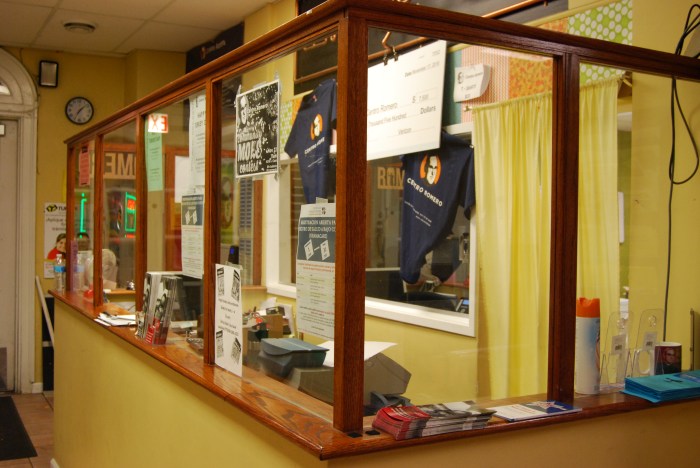
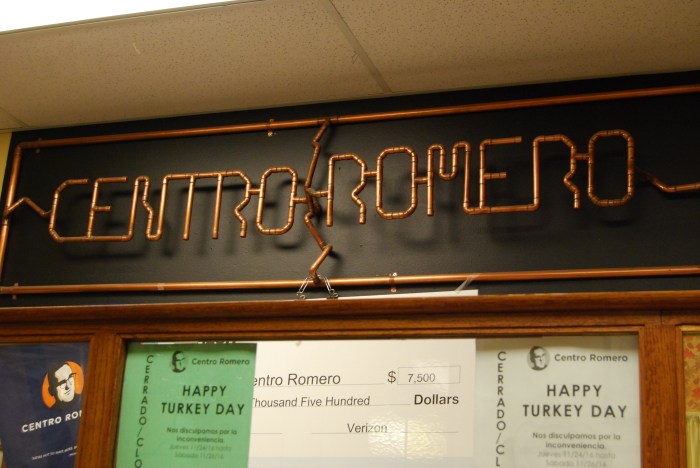
We believe that a person has a right to an education. At Centro Romero, education is not only a given, it is the reason for its existence. Every year, thousands of immigrants and refugees enter its doors to learn English, get a basic adult education, or get their citizenship.
Vienen de todos tipos de vidas, de todos lugares que puedes imaginar. Vienen a Centro Romero para buscar una educación que le dará mejores trabajos y el respeto de la comunidad de habla inglesa en Chicago. Están motivados por expectaciones, esperanzas, y sueños.
Some come to the center to learn English to go to college. Others come to communicate better with their children.
Cualquiera razón, llegan a Centro Romero con la esperanza de un día hablar el idioma que ayudará sus oportunidades de éxito.
ENGLISH
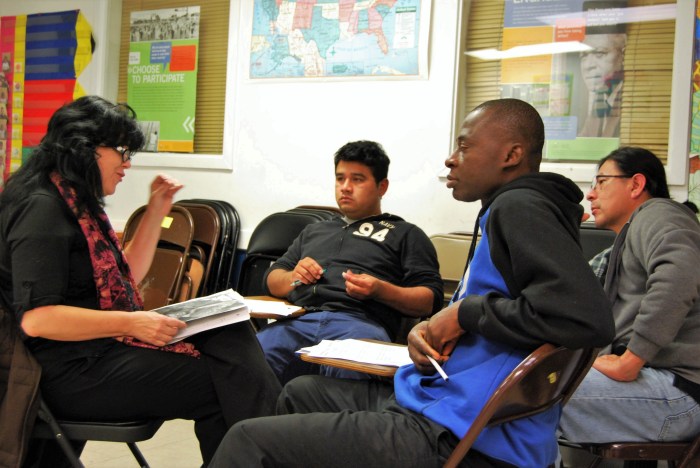
José García sits quietly in a fluorescent lit room, his eyes carefully switching between photographs and words. On his desk is a handout on mood and emotions, and the class works to describe the details in a series of photographs. One photo boasts an advertisement for a perfume, showing a fair-skinned model wearing a gold dress. Another depicts a yellow M&M standing in front of a golden Christmas tree, and the final shows a woman with her two children huddled behind her shoulders. García fiddles with a pencil, nimbly twiddling it between his fingers.
In the ESL classroom of Centro Romero, the walls host maps of Illinois and the United States as well as posters outlining how a bill becomes a law and the branches of government. The rickety wooden desks fill the room with creaky noise as the students shift in their chairs and stumble over words as they struggle with the English language. They may not be new to the classroom or Chicago, but they are new to the language that they hope will get them higher paying jobs and help create a pathway to citizenship.
Centro Romero has long been a source of success for immigrant and refugee families on Chicago’s Northside. Since 1984, the community-based organization has helped many immigrants access English as a Second Language (ESL), General Educational Development (GED), Adult Basic Education (ABE), and citizenship courses. Their mission, promoted on their website, is to “bridge a disenfranchised community of immigrants and refugees into mainstream American society as well as improving their opportunity for upward social mobility.” Recently, however, the services that Centro Romero offers have dwindled and resources for immigrants and refugees are at risk of being cut off.
Centro Romero was named after Archbishop Oscar Arnulfo Romero, who was assassinated at the height of El Salvador’s Civil War, and reflects Romero’s commitment to giving a voice to the voiceless. Centro Romero offers education, advocacy, leadership, and legal service to promote the growth of immigrants and refugees in the community. The center helps about 15,000 people per year according to Dena Giacommetti, the adult education program director. For this reason, Centro Romero never denies people access to their courses.
The community center faces pressure to stay open without state money due to the recent Illinois budget crisis, and as a result Centro Romero has had to deal with layoffs, furloughs and uncertainty about its future. In the last year, Centro Romero has lost 17 teachers but has been able to re-hire the majority of them. Family literacy classes are no longer offered and the center faces an influx of newcomers from other centers that have already closed down. Centro Romero was able to stay open by greatly reducing their services and with the help of numerous volunteers.
“It’s been a disaster. Centro Romero almost shut down last year because of budget cuts. It’s a gift that we’re still here,” said Debbie Kaputska, an adult basic education teacher.
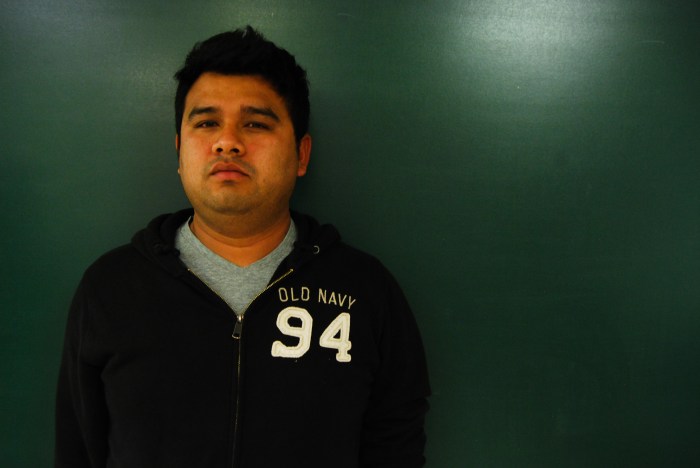
Carlos Cortez, a student at Centro Romero
For students like García, the closing of the center would devastate their chances of learning English or completing their GED or citizenship classes. The closing also poses a danger to other immigrants who may not have elsewhere to go to seek legal counseling services. For many, Centro Romero is the first place immigrants and refugees visit for help, making it an indispensable resource to the community.
“Centro Romero is important to me because here I can learn to interact with people from different countries and at the same time I make many friends,” said García. “It’s important because I can also help many people who truly need help.”
According to the Fiscal Policy Center at Voices for Illinois Kids, due to the lack of state funding going to immigrant services, “roughly 102,000 immigrants are no longer receiving services through the New Americans Initiative and the Immigrant Family Resource program”. These two programs provided services such as ESL classes and assistance with naturalization and citizenship processes — resources that Centro Romero offers and have been affected due to the budget cut.
“If it weren’t for fundraisers and community outreach events, the center might not be standing today. We fundraised like crazy,” according to Kaputska.
When adult education programs get the majority of their money from the state, the lack of a state budget is “not good news” for Katie Maranzana, the transitions coordinator at the center. Despite struggling and reducing its services, some centers were not as fortunate as Centro Romero. The Albany Park Community Center was forced to sell its building and shut down classes as a result of the budget cuts. According to Maranzana, this was the largest shutdown of any center to date.
Jose García, a student at Centro Romero
García, a recently naturalized US citizen and an immigrant from the Mexican town of Morelos, is shy and fidgety, his eyes low and his voice quiet as he talks about his life. He has lived in Chicago with his father and two younger sisters since 2011, has a brother who lives in Glenview, and his mother and another brother remain in Morelos. He found out about Centro Romero through his father, who has been living in the United States for over 20 years and who also learned English and became a citizen through Centro Romero’s classes.
“I come here every night so that I can some day be really good at English and go back to college and become an engineer,” said García. “My father learned English here and I will too.”
Many students must balance the realities of immigrant life with their classes at Centro Romero, often coming to class after a long day of working or tending to family. Whether it is to study English in order to get their GED, take citizenship classes, be qualified for a job, or to simply communicate better with family in the United States, each student at Centro Romero has their own story behind their desire to learn English. Despite feeling comfortable speaking Spanish in his home and at his job, a car wash in Glenview, García realizes the barriers that not speaking English creates.
“If you want a better job, you have to learn English and be a citizen,” said García.
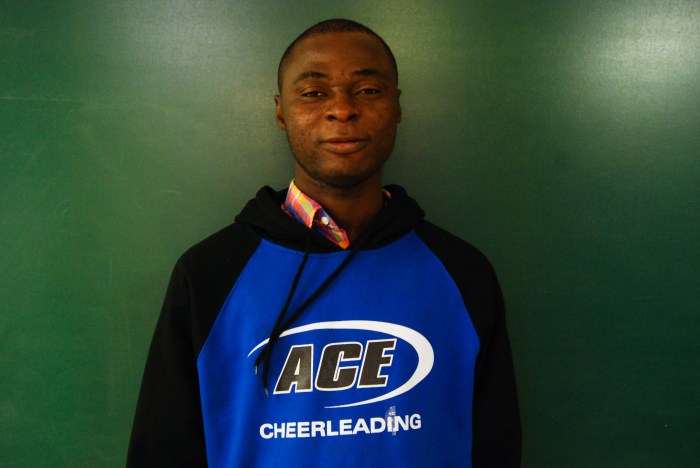
William Mensauh, a student at Centro Romero
Difficulties aside, Centro Romero’s role in the community remains as important as ever, especially in the aftermath of the continued budget crisis and the 2016 presidential election. Maranzana said that since the election, applications to volunteer have surged. The center, usually receiving around one or two applications per week, has received over 20 applications for volunteers in the weeks following Nov. 8. Maranzana also shared that when asked why they would like to volunteer at the center, one applicant simply wrote “to put it simply, the election and Donald Trump.”
Like Garcia, many students look to Centro Romero as a place where their hopes of speaking English will become reality. But this reality is not at all what it may seem to be. Staff at Centro Romero have expressed concern about the future of the center.
For Joseph Martens, a resource developer at the center, the future of Centro Romero lies in the hands of Donald Trump.
“We’re not sure what will happen now that Trump is in office,” said Martens. “Because he’s still the president-elect, nothing has happened. This may not be the case come January. We’re going to have to wait and see.”
SPANISH
José García está sentado callado en un cuarto con luces fluorescentes, sus ojos cuidadosamente alternando entre fotos y palabras. En su escritorio esta un papel sobre emociones y humores, la clase trabaja para describir los detalles en una serie de fotos. Una foto muestra un anuncio para un perfume con una mujer de piel clara con un vestido dorado. Otra ilustra un chocolate M&M amarillo parado en frente de un árbol de Navidad dorado, y la foto final enseña una mujer con sus dos hijos encorvados atrás de ella. García está jugueteando con un lápiz, pasándolo por sus dedos ágilmente.
En el salón de la clase en Centro Romero, las paredes muestran mapas de Illinois y los Estados Unidos y también carteles delineando cómo las propuestas de ley se convierten en leyes y las ramas del gobierno. Los escritorios ruidosos de madera llenan el cuarto con sonido porque los estudiantes se mueven en sus asientos, tropezando sobre palabras en sus esfuerzos para adquirir el ingles. Aunque no son nuevos al salón o a Chicago, son nuevos al idioma que les trae tanta esperanza de mejores trabajos y los ayuda a crear un camino a la ciudadanía.
Centro Romero ha sido una fuente de éxitos para familias inmigrantes y refugiadas en el norte de Chicago. Desde 1984, la organización comunitaria ha ayudado a muchos inmigrantes a acceder a clases de Inglés Como Segunda Lengua, General Educational Development (GED), Adult Basic Education (ABE), y clases de ciudadanía. La misión del centro, promocionada en su sitio web, es “conectar una comunidad de inmigrantes y refugiados privados de sus derechos a la sociedad popular americana y también mejorar sus oportunidades para movilidad social ascendente”. Pero recientemente, los recursos y servicios que Centro Romero ofrece han disminuido por el estancamiento del presupuesto estatal de Illinois.
Centro Romero lleva el nombre del Arzobispo Oscar Arnulfo Romero, quien fue asesinado durante la guerra civil de El Salvador, y refleja el compromiso que tenía Romero para darle una voz a los que no la tienen. Centro Romero ofrece educación, abogacía, liderazgo, y servicios legales para promover el crecimiento de inmigrantes y refugiados en la comunidad. El centro ayuda a casi 15.000 personas cada año, según Dena Giacommetti, la directora del programa de educación adulta. Por esta razón, Centro Romero nunca niega el acceso a sus cursos a nadie.
El centro comunitario está obligado a mantenerse abierto sin dinero estatal debido a la crisis presupuestaria de Illinois, y como consecuencia, Centro Romero ha recurrido a despidos, permisos, e incertidumbre acerca de su futuro. En el año pasado, Centro Romero perdió 17 maestros, pero han podido reemplear a la mayoría de ellos. Ya no se ofrecen clases de alfabetización familiar y el centro se encuentra con una afluencia de nuevos estudiantes de otros centros que han cerrado. Centro Romero pudo mantenerse abierto porque sumamente redujeron sus servicios y por la ayuda de los voluntarios.
“Ha sido un desastre. Centro Romero casi cerró el año pasado por los cortes al presupuesto estatal. Es un regalo que todavía estamos aquí”, dijo Debbie Kaputska, una maestra de educación básica adulta.
Carlos Cortez, un estudiante en Centro Romero
Para estudiantes como García, el cierre del centro devastaría sus oportunidades de aprender inglés o terminar sus clases de GED o ciudadanía. El cierre también sería terrible para los inmigrantes que no pueden ir a ningún otro lado para conseguir servicios legales. Para muchos, Centro Romero es el primer lugar que los inmigrantes y refugiados visitan para pedir ayuda. Los servicios que Centro Romero ofrece son indispensables para la comunidad.
“Centro Romero es importante para mí por qué aquí puedo aprender a interactuar con personas de diferentes países y a la vez hacer muchos amigos”, dijo García. “Es importante porque también puedo ayudar a muchas personas que en verdad necesitan ayuda.”
Según el Fiscal Policy Center at Voices for Illinois Kids, debido a la ausencia de fondos estatales que lleguen a los servicios de inmigrantes, “casi 102.000 inmigrantes ya no están recibiendo servicios del New Americans Initiative y el programa de Immigrant Family Resource”. Estos dos programas proporcionaron servicios como clases de ESL y asistencia en los procesos de naturalización y ciudadanía — recursos que Centro Romero ofrece y que se han visto afectados por los recortes.
“Si no fuera por la recaudación de fondos y eventos de participación comunitaria, el centro a lo mejor no estaría aquí hoy. Recaudamos fondos como locos”, según Kaputska.
Cuando los programas de educación para adultos reciben la mayoría de sus fondos del estado, la falta de un presupuesto del estado “no es buena noticia” dijo Katie Maranzana, la coordinadora de transiciones en Centro Romero. A pesar de sus luchas, otros centros como Centro Romero no fueron tan afortunados. El Albany Park Community Center tuvo que vender uno de sus edificios y parar las clases por los recortes presupuestarios. Según Maranzana, esto ha sido el cierre de un centro más grande en la historia.
Jose García, un estudiante en Centro Romero
García, un ciudadano recientemente naturalizado y un inmigrante del pueblo mexicano de Morelos, es tímido y azogado, sus ojos miran al piso y su voz es baja mientras habla sobre su vida. Ha vivido en Chicago con su padre y sus hermanas menores desde 2011. Tiene un hermano que vive en Glenview, pero su madre y otro hermano están todavía en Morelos. Se enteró de Centro Romero por su padre, quien ha vivido en los Estados Unidos por más de 20 años y quien también aprendió inglés y se hizo ciudadano con la ayuda de las clases del centro.
“Vengo cada noche para algún día saber el inglés bien y para regresar a un colegio y ser un ingeniero”, dijo García. “Mi padre aprendió inglés aquí y yo también lo haré.”
Muchos estudiantes tienen que manejar las realidades de sus vidas inmigrantes con sus clases en Centro Romero, muchas veces llegando tarde después de un día largo en el trabajo o cuidando familia. Si se trata de aprender inglés para obtener el GED, tomar clases de ciudadanía, ser calificados para un trabajo, o comunicarse mejor con la familia en los Estados Unidos, cada estudiante tiene una historia al fondo de sus deseos de aprender inglés. A pesar de sentirse cómodo hablando el español en su casa y en su trabajo en un lavado de autos en Glenview, García entiende que no es suficiente hablar solo el español.
“Si quieres un trabajo mejor, tienes que aprender inglés y ser ciudadano”, dijo García.
William Mensauh, un estudiante en Centro Romero
A pesar de las dificultades a las que Centro Romero se ha enfrentado, su papel en la comunidad es más importante que nunca, especialmente después de la crisis presupuestaria y las elecciones presidenciales de 2016. Maranzana dijo que desde las elecciones, el número de voluntarios ha subido. El centro normalmente recibe una o dos solicitudes para ser voluntario cada semana. Pero en las semanas después del 8 de noviembre, el centro ha recibido 20 aplicaciones. Maranzana compartió que cuando les preguntaron a los solicitantes por qué quieren ser voluntarios, un solicitante dijo: “en breve, por las elecciones y Donald Trump”.
Como García, muchos estudiantes consideran Centro Romero un lugar adonde sus esperanzas de hablar inglés se pueden realizar. Pero esta realidad no es como aparece. Empleados de Centro Romero han expresado preocupación acerca del futuro del centro.
Para Joseph Martens, el coordinador de recursos del centro, el futuro de Centro Romero está en las manos de Donald Trump.
“No estamos seguros que va pasar ahora que Trump está en el poder”, dijo Martens. “Porque todavía es el presidente electo, nada ha pasado. Esto a lo mejor no será el caso en enero. Tendremos que esperar y ver”.
Originally posted on Ouch My Ego! on June 29, 2016.
Embracing the Ethereal with Yumi Zouma
I am up on the stage of The Historic Cine El Rey, and the lights are bright. Really, really bright.
The entire crowd of Galax Z Fair IV has been invited to dance with the members of Yumi Zouma during their song “Sålka Gets Her Hopes Up”, each of us taking care as we climb the stairs and join them on stage. Smiles abound, and everyone on stage is singing the chorus’s reassuring opening lyrics, “I’ll catch you if you’re falling.”
That night, along with the countless others celebrating and dancing on stage, I fell for Yumi Zouma, and don’t think I’ve quite yet hit the ground.
The four-piece group out of New Zealand captured the hearts and ears of listeners with their equally dance-y and dreamy pop music. Yoncalla, the band’s first full-length LP, grows and expands from their previous two EPs to focus on twinkling, swooping synths, delicate guitar-work, and the fresh, melodic vocals of Christie Simpson. After working from different corners of the world for years, Yoncalla sees Yumi Zouma creating a strong, perfectly cohesive debut record.
“The biggest difference was when we wrote and recorded Yoncalla, we spent so much more time together – where the EPs were made while we were spread apart, and we would write by sharing things over the Internet,” said Josh Burgess, who plays synths and guitar for Yumi Zouma. “This was the first time that we all sat down together, and we were in the same room, and we were working on music together.”
Aside from their meticulously constructed sound, Yumi Zouma is also skilled at crafting interesting titles that pique one’s attention and create a lasting relationship with their music. Take Yoncalla, for example. While on tour last year, the band spent three or four days in Yoncalla, a “small, weed-growing town” in Oregon, and wrote some of the LP there.
“We’re fond of it, and we’re always looking for places that sound interesting or words that sound nice, and we keep them and use them for song titles,” said Burgess. “I think sometimes people don’t pay too much attention to what records or songs are called, and we like to give them a distinct flavor.” Similarly, the track “Haji Awali” gets its name from aspects of Burgess’s childhood.
“‘Haji Awali’ is kind of an amalgamation,” said Burgess. “I grew up in the Middle East in Bahrain. Haji Hassan was the apartment complex we lived in, and then Awali was the school I went to. So again, it doesn’t translate to much of what the song’s about or anything, but I think it’s just kind of interesting.”
Finding a home in the abstract and the aesthetic, Yumi Zouma’s signature sound is fleeting and beautifully minimalistic – like a glimmer of sunlight caught off of water, or the delicate pastel hues of a sunset. They complement their airy, dreamy pop sound with equally dream-like artwork for their releases, giving a truly creative package.
“I think there’s something to be said about keeping people’s ability to use their imagination of what a band is like or what people are like.”
The band, however, is attempting to keep a minimalist image in a world of maximalism, instant Google searches, and frequently re-hashed interviews. The album’s cover art, designed by New Zealand artist Henrietta Harris, plays on the coy anonymity they had previously established with their beautiful EP artwork.
“I guess we kind of wanted to be on the cover in some way, but not in the way that was like, a Beatles record or something with all of us standing in a line,” explains Burgess. “I think there’s something to be said about keeping people’s ability to use their imagination of what a band is like or what people are like. I suppose that it’s a little bit different now with the Internet and just the amount of content around a band is so much higher. Now there are so many interviews with us and so many pictures of us that it’s harder to get lost in the mist of something, so maybe that was kind of behind the [idea of] ‘not having the faces’.”
Despite their wish to blend in, the band has clearly been a stand-out act, and have remained on the radar of countless music blogs and tastemakers. This summer marks Yumi Zouma’s second year performing at Gorilla Vs. Bear’s annual music festival, and 2016 sees them returning to McAllen a little over a year after their captivating Galax Z Fair IV performance.
“I think there is something…it [Texas] definitely feels very exotic,” says Burgess. “We really didn’t understand where McAllen was. Our booking agent booked it, and it was a show that we all just really loved. The people were really kind and really excited, and we just came to go back and revisit those people and that sort of place.”
Yumi Zouma is playing this Friday, July 1 at Yerberia Cultura in McAllen. Event information can be found here, and tickets can be purchased here.
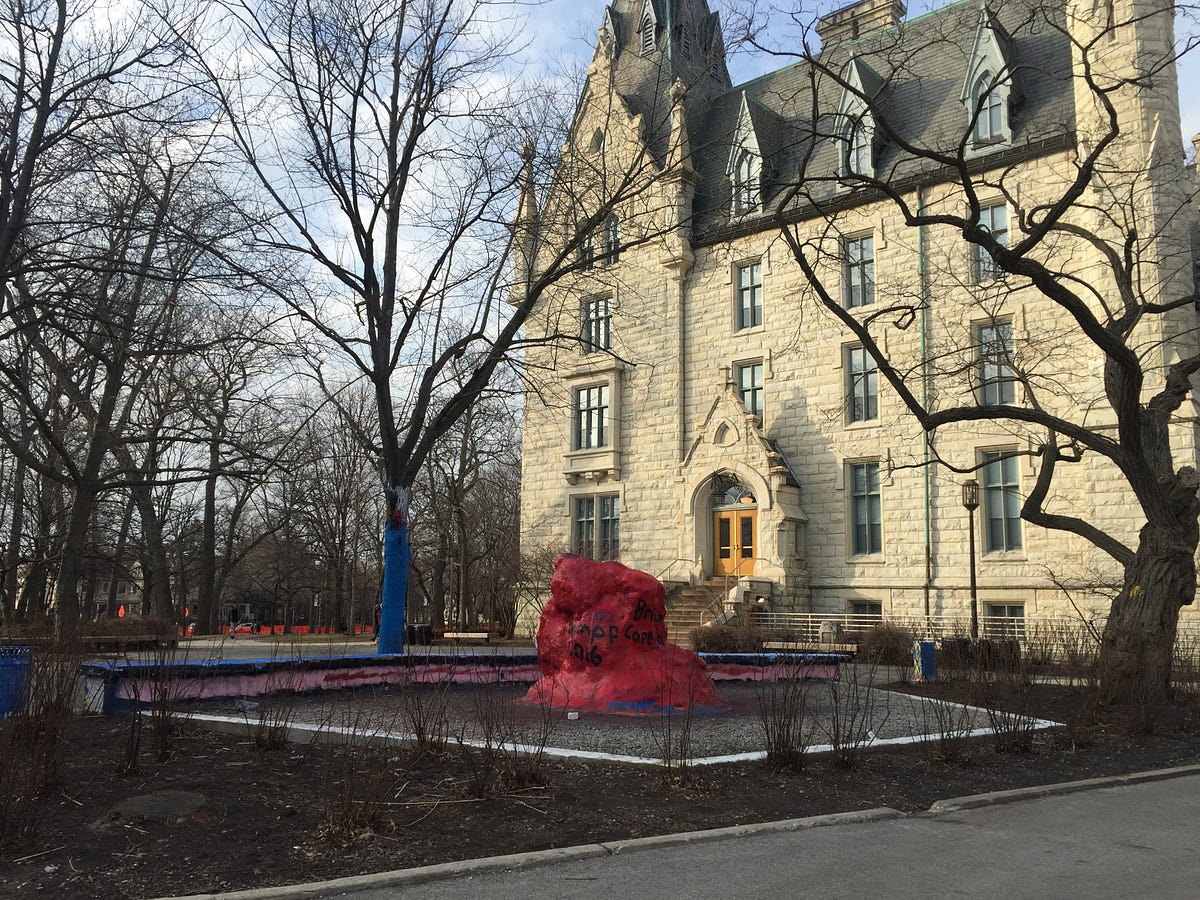
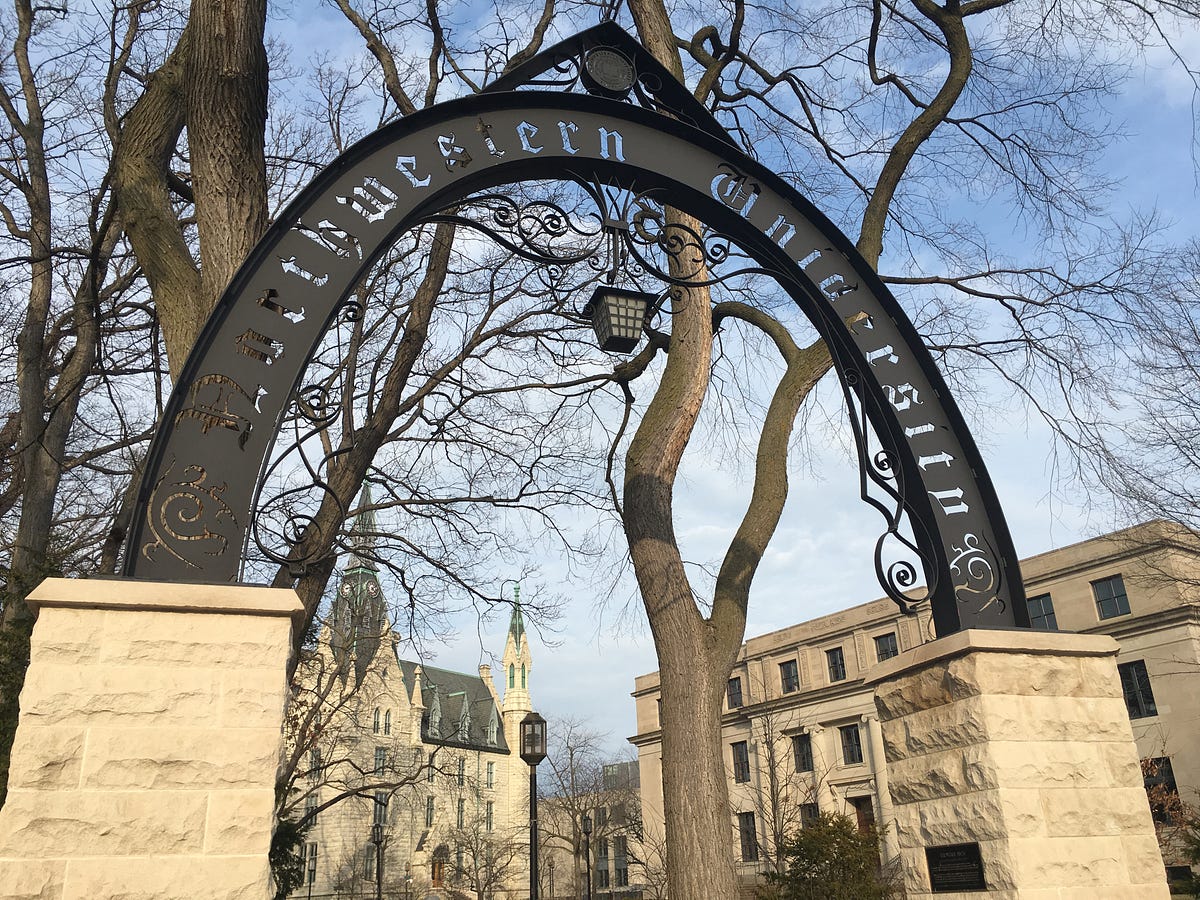
Northwestern University, a campus settled right along Lake Michigan in the quiet suburb of Evanston, Illinois, has a long history of valuing tradition, to the point that student identity and success is driven more by religious dedication to these traditions than by academics. One shouldn’t walk through “The Arch” during finals week. One has to guard “The Rock”, nestled in between Harris and University Hall, on campus for 24 hours before getting the honor of painting it. Northwestern’s nature is embedded in these quirky, unspoken rules that define the campus’ culture, but “The Rock” and “The Arch” are not the only thing contributing to the legacy of traditions of the school.
“The Rock” and “The Arch”
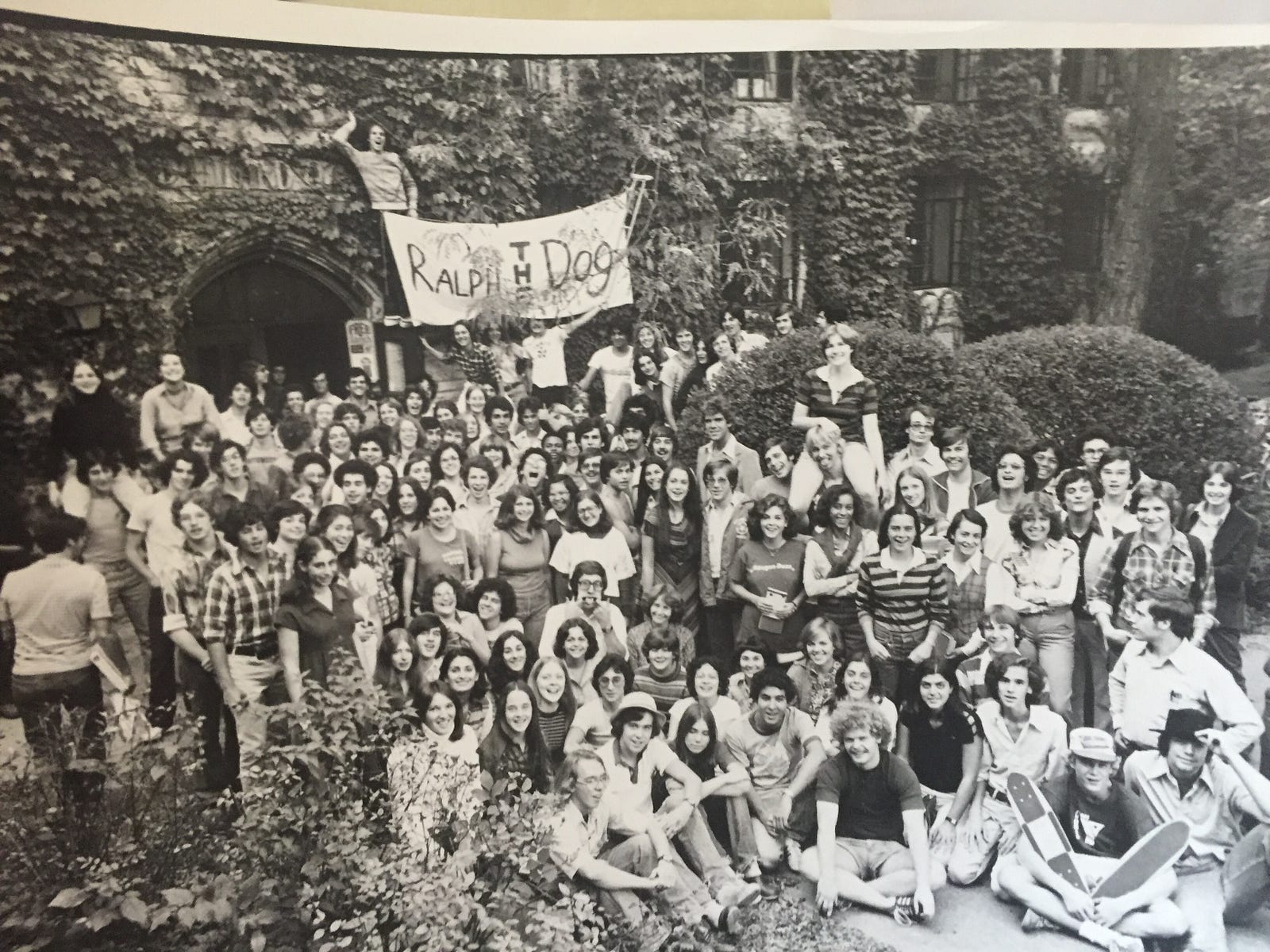
Hidden on the Southwestern-most tip of campus, Willard Residential College is home to possibly the most eclectic mix of people on campus. From its celebrity alumni such as Julia Louis-Dreyfus and Stephen Colbert to beloved events such as the Woo-Shep Olympics, an annual showdown against Willard’s rival residential college, Sheppard, Willard allows for people of all different majors and backgrounds to come together and continue to celebrate the customs that help embed Willard’s identity within the Northwestern community.
A Portait of Willard in the Northwestern University Archives
Willard Residential College is named after the formidable Frances Willard, Northwestern University’s first Dean of Women. The life of Frances Willard in some strange way has very much set the tone for the residential college’s unique community and its culture of “social innovation”. Willard was a key player for temperance, which most people know led to prohibition but was instrumental to early women’s rights. Her involvement with the Women’s Christian Temperance Union was lovingly mocked by Willardites through parties involving heavy drinking on the anniversary of her death (they were finally stopped in 2002). Willard’s quirky residents find a great deal of joy in their namesake, often cracking jokes about the ghost of Frances Willard or gathering in the Common Room to take selfies with her portrait.
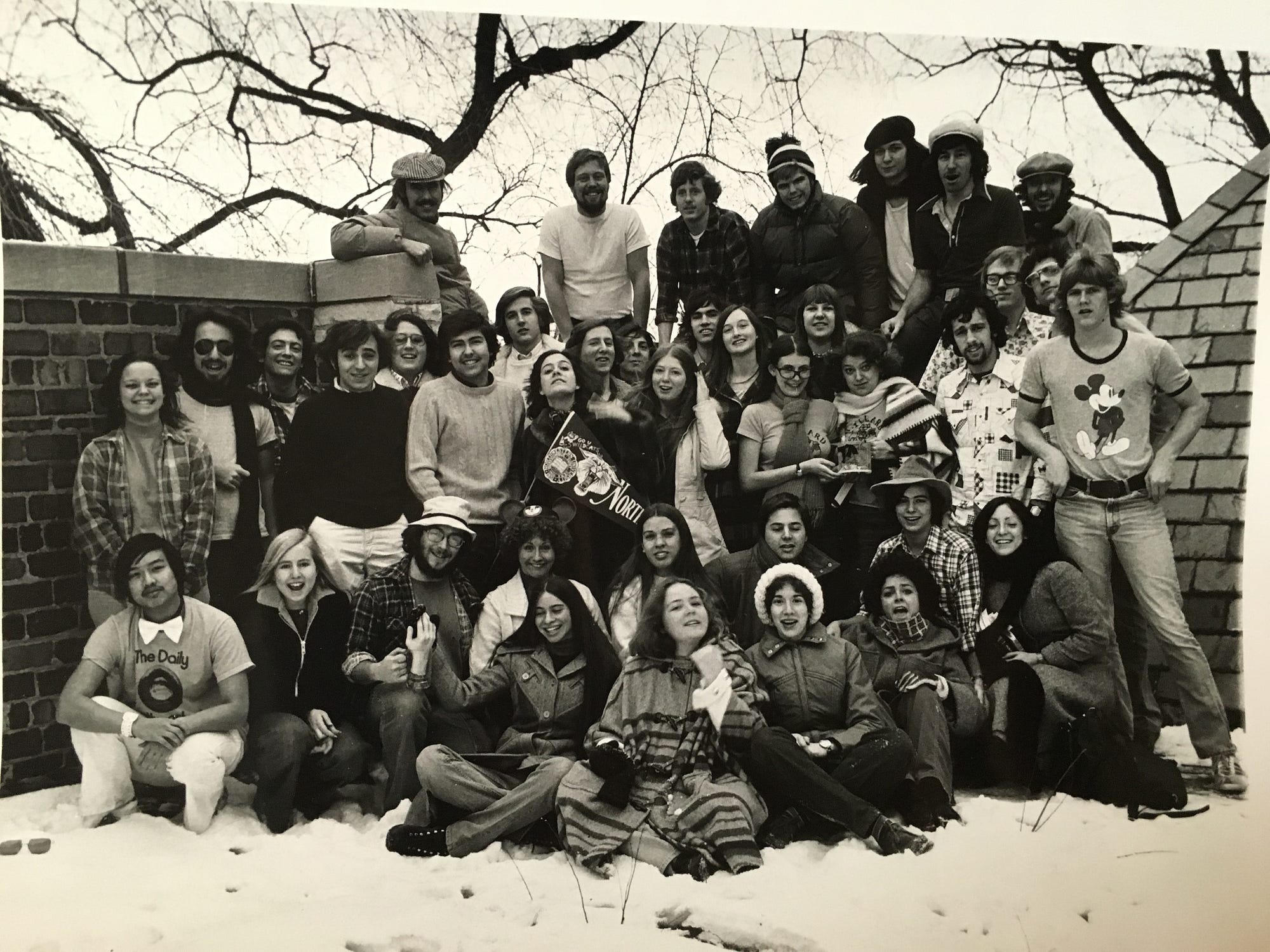
Willardites on the roof of Willard Hall c. 1970
However, Willard’s playful and creative nature faces a great opponent: Northwestern’s Housing Master Plan. Willard will be under renovation for the 2016–2017 school year and the residential college will be operating out of 1835 Hinman, a residential hall. While it may be “Willard East” for the following school year, many residents worry that the distinctive character that the building and Willardites hold together will be lost.
The physical building of Willard holds a great deal of tradition. Each room is constructed differently, some with broad, slanted walls that make one wonder what posters have hung there in the past. Old lounges that have been repurposed into triples are found on each floor, some given funny names such as “Paradise”. The common spaces have names that only a Willardite could come up with: the TivLounge (TV Lounge), the Rat Trap (the basement), the Clounge (computer lounge), to name a few. From floor to floor, each part of the Willard building exudes the quintessential quirk and charisma that its residents do.
Yoko Kohmoto, Willard’s current president, believes that while Willard’s traditions and culture will be moving to Hinman for a year, the building is inextricably tied to its identity and customs.
“A lot of the furniture and things are moving over to Hinman and the new executive board will handle the continuing of the events, but I think things will be different,” Kohmoto said. “It’s a unique situation to be living in because all the lounges have weird names… and that becomes a part of our language which shapes the community into something that is special on campus.”
Hale McSharry, who lived in Willard in his freshman and sophomore year, discussed the excitement that came with living in a dorm rich with history.
“My sophomore year I lived down the hall from where Stephen Colbert lived, and someone once told me that the fifth floor was a tuberculosis quarantine,” McSharry said. He also echoed concerns about how the buildings structural differences would change the way Willard residents would interact with each other in 1835 Hinman.
“Hinman is a weird building. I had friends who lived in Hinman and because they had the suite-style living, and the way they talked about the people that they lived with was much different,” McSharry said. “I miss the energy that just comes from so many people living on top of each other.”
The direct attachment to Willard as a building and as a community extends well beyond graduation, and Willard alums fondly recall their time spent in the Residential College. Jack Hynes, Northwestern ’76, commuted from his home in Chicago’s northern suburbs his first year, then lived in Willard for his sophomore and junior years of college. To him, Willard has always been a coveted place to live that cultivates close relationships.
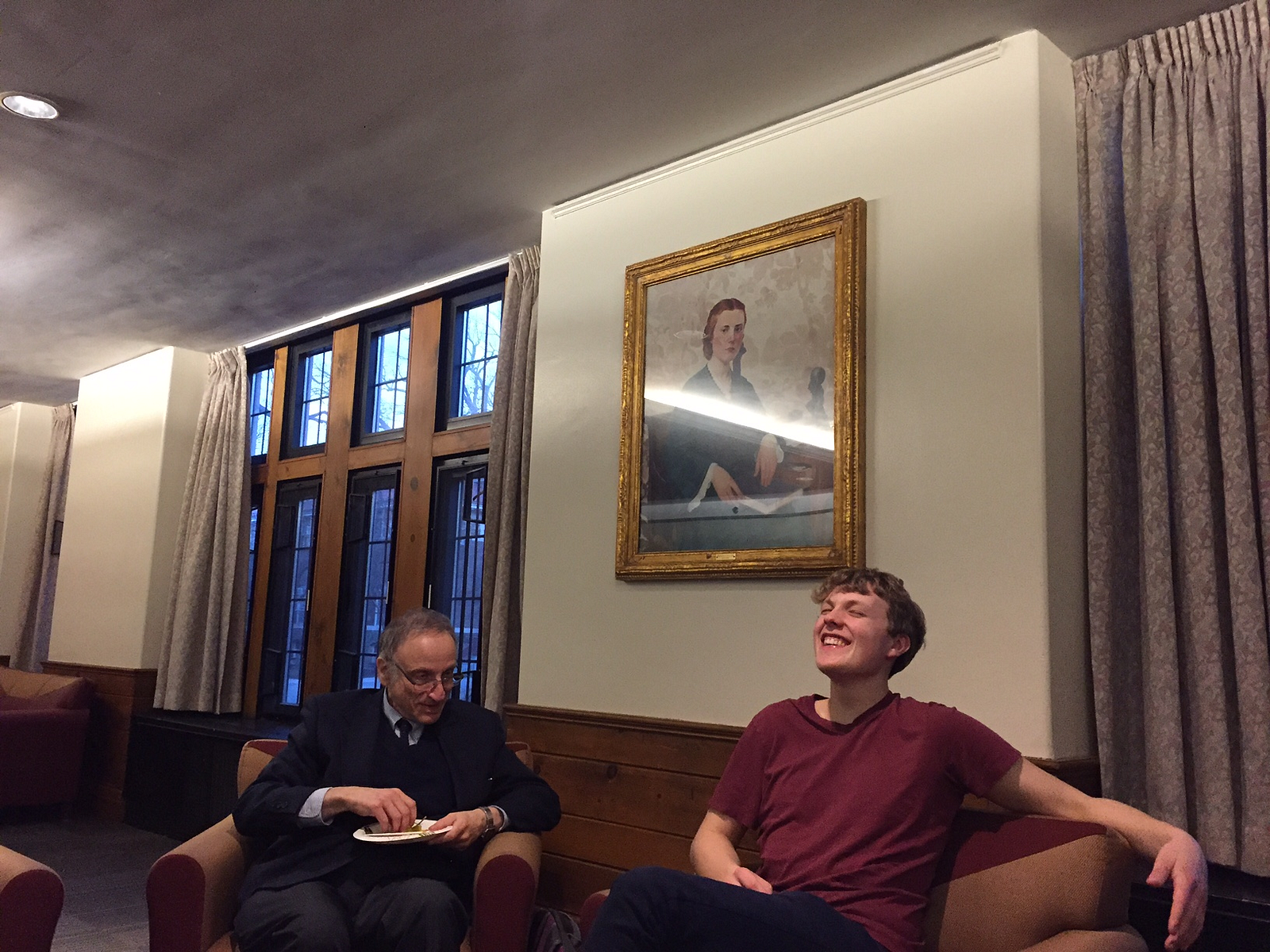
Faculty Chair Gary Saul Morson and Willard resident Drew Johnson enjoy a conversation together in the Common Room, accompanied by Frances Willard’s portrait.
“There was a housing shortage at the time and I got the last room in Willard. They converted a lounge into a quad, so I lived with three other men,” Hynes said.
Hynes also discussed Willard’s spontaneous nature and college antics. When retelling some of his and his roommates stories, Hynes said “it was because we had become such great friends the year before that we had all come back… Willard was a really nice place to live, and there was a lot of social activity. It had just become a residential college and pretty much every week, there was some type of event going on.”
Willard continues to be a place where diverse experiences and perspectives converge and particularly strong friendships, and even some student groups, are forged. For instance, Dial Up, a bi-weekly radio show that broadcasts on WNUR, Northwestern’s student-run radio station, was the result of a tight knit community of friends who all met Willard.
Tucker Johnson is a student currently living in Willard. His father and his uncle both lived in the dorm and encouraged Johnson to do the same when housing selection came around. Tucker lives on the third floor in room 336, which has unofficially been dubbed “The Chateau,” complete with a sign that has been passed down for several years.
Johnson, however, has decided he will be holding onto the sign throughout Willard’s remodeling because “Willard won’t be Willard next year.” Many students share this concern and claim that with its relocation, Willard will be fundamentally different. After an informal survey put out by the executive board, Kohmoto says that only about 15 to 20 sophomores will be returning to “Willard East”, which pales in comparison to the 51 students who returned to live in Willard for the 2015–16 school year. With less than ten percent of students returning to live in “Willard East,” it’s natural to question the amount to which Willard’s traditions will continue.
Some people, however, believe that the culture of Willard will continue to thrive, so long as Willardites, no matter their number, continue to uphold its traditions. Gary Saul Morson is a Professor of Russian Literature and has been the Faculty Chair of Willard Residential College for 13 years. With the move to Hinman, Morson has insisted on keeping up the little things that make Willard special, such as moving the posters that hang in Willard as well as the staff of Fran’s Cafe, an immensely popular late night dining option in Willard’s dining hall.
“The staff makes a real difference and people underestimate that for setting a tone and making a difference and making it feel like home,” Morson said.
Alex Millinazo, Willard’s secretary, also believes that though the move might be a little rough, Willard’s rich culture and history will be maintained.
“There might be a few things that unfortunately might get lost in translation, but all of the major things that I think keep Willard what it is will be held up consistently,” Millinazo said.
Current Exterior of Willard Residential College (via northwestern.edu)
Swipe left. Swipe left. Swipe left. Swipe right. The sudden flick of the thumb across the screen of his iPhone 6 is how Colin Clayton, a 19-year-old student at Northwestern University from Edwardsville, Illinois, navigates through the dating app Tinder in order to find a potential match. A swipe left means a pass, while a swipe right indicates interest. In these simple motions, a relationship is born.
“I really like Tinder because I meet people who are outside Northwestern. You meet different people that you wouldn’t normally meet,” said Clayton. “Especially as a gay person, the dating scene is very digital. It’s harder to meet people just in public out and about.”
Young Americans are more connected than ever. According to Pew Research, 45 percent of Internet users ages 18-29 in serious relationships say the Internet has had a serious impact on their relationship and 11 percent of American adults have used online dating sites or mobile dating apps.
“I think there’s been the capacity to meet people online for a long time, but there’s been a social stigma surrounding it,” said Karen North, a professor of digital social media at the University of Southern California in a phone call. “The reality behind what’s really happening is that socializing with people via social media has very recently become acceptable enough for people.”
For many in relationships – particularly long-distance relationships – technology is often what allows couples to remain connected while apart. Nicole Paykert, a 23-year-old legal secretary from East Meadow, New York, has been in a long-distance relationship with her boyfriend, David, who lives in Liverpool, England, for almost three years. The couple met on the blogging platform Tumblr and stay connected through WhatsApp, Skype, Xbox Live and social media.
“There are days when I come home from work stressed or really excited about something and I wish I could come home to David,” Paykert said in a phone call. “I call him when I get out of work and that sometimes helps, but it’s not the same as when we’re together and I can just plop down on the couch and just be with him. And if either of us isn’t answering or the app isn’t working or our phone’s crash, then we’re cut off.”
An informal survey regarding technology and relationships created by this writer was conducted with 250 anonymous individuals ages 18 to 29 years old. Fifty-two percent of survey respondents said they would use a dating app to find a future partner.
“I think for students it [online dating] is seen as a little bit weird and stigmatized,” said Jeremy Birnholtz, a communication studies professor at Northwestern University. “You have endless social opportunities to interact face-to-face with people your own age, and the fact you would choose not to do that and instead meet people online is a little bit weird. But once you get out into the real world, you’re not surrounded by people who are just like you anymore.”
However, one app – Tinder – has potentially cracked the code of getting the college-aged demographic to use dating and matchmaking services, exploding in popularity since its start in 2012 and garnering over one billion “swipes” per day. In the same informal survey, almost 40 percent of respondents stated that they have used Tinder, which gives significant reason to believe that the stigma surrounding younger individuals using dating apps and websites is slowly diminishing.
“Tinder may be the breakthrough though because it’s simple and location based,” said North. “With Tinder, you also don’t have to put up a profile. You just put up a picture and you don’t have to put up a lot of information.”
SOURCE: Isabella Soto / Northwestern University
Some young adults, however, are choosing to meet their partners the old-fashioned way: in person. Claudia Harmata, 19, is a Northwestern University student from Chicago who met Connor, her boyfriend, on the second day of their freshman orientation.
“I was with a friend and she introduced us, and then a few days later we all met up again and as we talked more, we found out we lived ten minutes from each other,” said Harmata.
They then started talking frequently on Snapchat, the instant photo-messaging app, since signal problems caused issues between the two when texting.
“Ever since we started dating, we’ve started talking a lot less on technology,” said Harmata. “We see each other in our dorm every day, and mostly we’ll send each other texts to coordinate when to meet up.”
Constant connectivity, however, has enabled individuals to be hyper-aware of what’s going on, when it’s happening and who’s involved, especially in the aftermath of failed relationships. Oscar Peinado*, a 21-year-old junior at the University of Pennsylvania from McAllen, Texas, was in a relationship with another university student for seven months before it ended and cites that Facebook has made it harder to cut ties with his ex.
“With respect to my ex, who I think sees basically everything I post and comment on because she is very active in social media and follows my closest friends, I try to maintain the image of myself that I had while together so that I don’t appear as though I’ve lost my s–t,” said Peinado. “My Facebook usage has been much more active, and I’ve been more open about what’s going on in my personal life and have shared recent successes knowing that my ex will see them.”
As the world becomes more connected and technology continues to evolve and find spaces in even our most intimate relationships, more individuals are now able to find truly compatible partners and create a love that extends beyond the software it was founded upon.
“People always ask why I would be in a long distance relationship if it was so tough,” said Paykert. “I’d rather be in a long distance relationship with him, where we get each other perfectly and we really love each other than settle for anything less with someone close by. What we have is worth it.”
I have always felt strangely disjointed while living in the Valley. With both of my parents from the Dominican Republic, being a first-generation American and living in the Rio Grande Valley created a singular yet slightly fragmented way of growing up. Dominican customs and traditions and American ideals intersected among the heavily-influential Mexican culture in the Valley. Even after living in the Valley for over 18 years and being active within our own Dominican community here, it’s an intimidating and overwhelming feeling when you know you’re on the same Latinx wavelength as the people around you, but there’s still a hiccup in your Valley identity because of your similar yet inherently different customs.
I had never been able to truly verbalize this discomfort or pinpoint where it stemmed from, but I knew this feeling of un-belonging to my own community is where my desire to leave Texas came from. As a child, I wanted to become an illustrious pastry chef and study in New York, working towards the ultimate goal of becoming a Food Network star. I had never felt tied down to my hometown with the exception of family, friends, and my pets, and figured I’d have nothing to lose if I left. Though times have changed and though my career interests don’t exactly line-up with my eight-year-old self anymore, I’m still fulfilling my childhood dream of attending school outside of Texas; I’ll be studying Journalism at Northwestern University in Illinois beginning this fall. However, I’m finding it harder than I ever could have expected to say goodbye.
At the beginning of this final summer (because for all intents and purposes, this is my final summer as an official resident of the Rio Grande Valley), I became involved with an internship with the wonderful people at Curando RGV, which describes itself as “an intersectional community organization empowering our people in a variety of ways through activism, the arts, local history, and culture.” I had grown involved with the social justice scene in the Valley, but wanted to find a way to make more of an impact and figured this internship would steer me in the right direction.
Though I selectively chose to involve myself in the Media and Reproductive Justice committees, the internship proved that I would be working in all aspects to help improve the Valley; I’ve been volunteering as a clinic escort at Whole Woman’s Health in downtown McAllen throughout the summer, and as a whole we’ve volunteered at the McAllen Nature Center, visited ARISE in Alamo and saw the powerful and important work they are doing to help low-income immigrant families, and helped collect clothing for Curando RGV’s donation drive for the Refugee Center at Sacred Heart Church. I’ve experienced the Valley in such an incredible way. However, I never thought that the social justice work we were doing would intersect with the one thing I admittedly love most: music.
I witnessed the power and influence that comes from the intersection of music and social justice at Galax Z Fair — a two-day festival put on by Tigersblood.org that takes place during Spring Break — where the festival and a demonstration involving the Caravana 43 coincided. Galax Z Fair became a space for the family of those disappeared 43 students to speak to an audience of mostly high school and college-age individuals and to alert and educate them on the heinous situation they were enduring and what we could do as a community to get closer to the justice that their loved ones deserve.
“A border culture is a beautiful culture, and I wish more of us here, as well as other alternative media outlets, realized this.” – Patrick Garcia
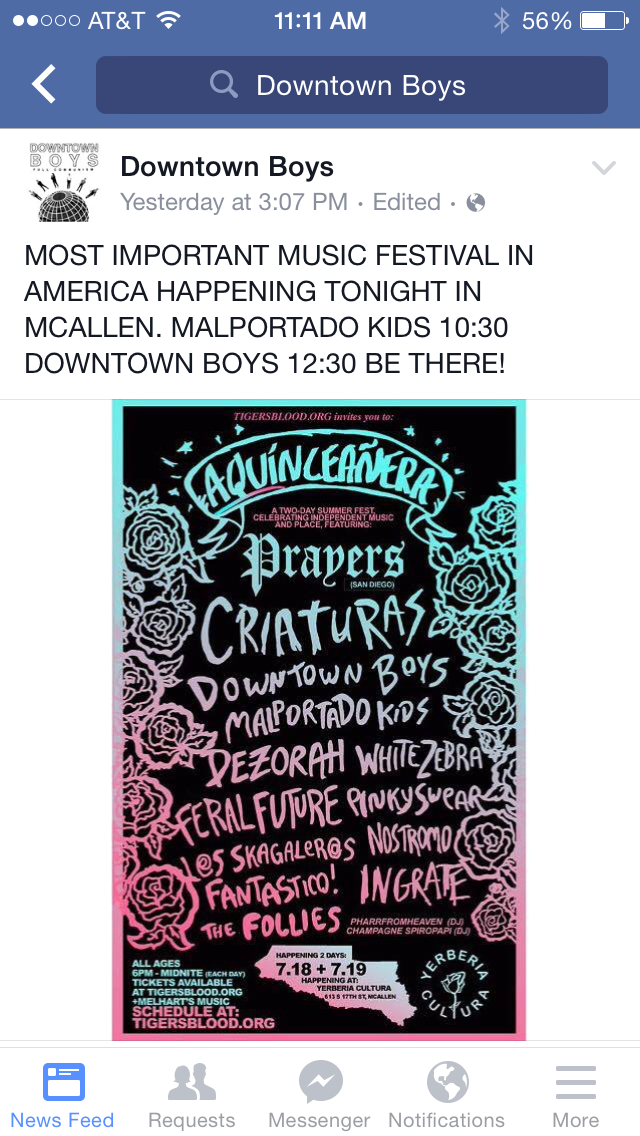
At the beginning of the summer, word began flying around that a new, two-day summer music festival was in the works for McAllen. AQUÍnceañera was to be a totally unique festival; a celebration of place and independent sound complete with a brand-new venue devoted to culture, creativity, and inclusion. In my case, the initial announcement of the festival didn’t relay its immediate importance. Of course I was excited that there was another festival happening quite literally in my own backyard, but I was expecting something along the lines of Galax Z Fair.
However, AQUÍnceañera strayed far from any and all music festivals I’d attended in the past. AQUÍnceañera was an entity of its own, incomparable and immeasurable in importance to the countless other summer music festivals happening. There may be words in existence to describe what occurred AQUÍnceañera, but I don’t believe there exist words to describe how being at AQUÍnceañera felt.
“In the Valley, nearly everyone is a person of color. And if one throws a local fest, I mean, that’s ultimately what it’s going to be. But the idea of celebrating that element, as well as place, is a narrative I wanted to see revived, reminded, and asserted.” – Patrick Garcia
Walking into Yerberia Cultura for the first time was like walking into a friend’s backyard; it felt like home. Though I attended the first day of the festival alone, I didn’t feel alone in the slightest. I saw the familiar faces of those active in the local music/activist scene, I saw some well-known friends, but the electricity in the air of finally having a safe and familiar venue was intoxicating and enough to make being alone completely comfortable. Throughout the evening, which was filled with dancing to Selena out on the patio and complete with a Donald Trump piñata, I went around asking friends at AQUÍnceañera their thoughts on the festival, which allowed me to see that it wasn’t just me surging with feelings of love and community those two nights.
“It’s important because it’s really easy to lose your culture. […] Here, it’s everywhere. It’s expressed in all the art being made. You’re with your own people and your own culture.” – Myriah Acosta
“I think it’s important because you are celebrating what you are. I feel like in the Valley we always try to be ‘we want to be like Austin’ or ‘we want to be like San Antonio’, and this is a counter to that. We don’t need to be that; we are something different. In my opinion better, but it’s definitely different, and I think it’s beautiful. There’s nothing like this.” – Edgar Gonzalez
From Danica Salazar’s throaty pleas of “DON’T FORGET YOUR PLACE” during DeZorah’s final song to Victoria Ruiz’s constant affirmations of love for McAllen and the Rio Grande Valley throughout both Downtown Boys’ set and the days preceding the festival via social media, it was obvious that AQUÍnceañera stood for something far and beyond the music.
The festival did not occur in a vacuum in which music and social issues were mutually exclusive and where we would all return to our daily lives and recount the weekend’s events as just another concert. It became a space where important issues, such as the brutalization of black and brown bodies at the hands of police, feminism, immigration justice and reform, and the the Valley’s first-ever conference for queer people of color, were openly and publicly discussed within and alongside the music and persisted within the festivalgoers. Before Malportado Kids exited the stage band member Joey DeFrancesco said, “We’ve been all over the country this month and this is the most special thing we get to do.” In those moments was impossible to acknowledge the beauty and singularity of the place where we live.
I left the venue that night feeling warm and starry-eyed, and that warmth continued onwards into Aquí Estamos, the Rio Grande Valley’s first-ever conference focusing solely on LGBT people of color and the intersections that those identities bring about in the RGV. Full of insightful workshops, knowledge-sharing activities, and beautiful and positive individuals committed to making the Rio Grande Valley a safe and equal space for lesbian, gay, bisexual, transgender, and queer-identifying people of color, Aquí Estamos was a learning experience and a chance to communicate with individuals who we may not necessarily see or hear about in our every day lives. Taking part in such a critical and pivotal movement was a reality check in the practices of what allies like myself should be doing in order to bolster the voices of these individuals and what we as a community must do in order to continue being an equal and safe space for everyone in the Rio Grande Valley.
The humid South Texas air blew slowly and quietly as Romeo Santos’ voice echoed throughout the patio of Yerberia Cultura. The venue was celebrating its opening eve by hosting the after-conference dance party for Aquí Estamos. As I stood in the circle of dancers, swaying my hips and spinning in time with the music, I soaked in the moment. There was a feeling of lightness, of comfort, of pure joy that I felt dancing under Yerberia Cultura’s hanging lights. I felt a connection with everyone dancing with me, even if I wasn’t necessarily the closest of friends with anyone there. The hesitation and trepidation I previously felt of not being a “true part” of my community dissolved in the night.
I realized a had a true and established home here, even when it didn’t feel like it sometimes, and realized I would miss everything about the Valley. I would miss these South Texas nights. I would miss raspas and elote and marranitos and spiropapas and conchas. I would miss the manager at my local Walgreens that sees me so often he’s started calling me “mija”. I would miss the electricity that erupts and overflows from the crowds at Cine El Rey. I would miss being a part of this community. And within the realization of everything that I would miss, that evening, I felt more present than ever. I felt powerful and whole and at home.
Originally published in the October issue of InkArt, a collaborative student-run literary magazine published between Sci-Tech and Med High
Music festivals are pretty scary places. Between the throngs of strangers, the ridiculous amount of bands present (and the set conflicts that ensue – EEEK!), rampant cultural appropriation (PSA: bindis and Native American headdresses are NOT fashion items), and the very real possibility of you not making it to a port-a-potty in time, it becomes fairly clear why people avoid these massive concert events. However, Austin City Limits consistently continues to be one of the best ways for people (especially teenagers in high school who don’t live fairly close to big cities) to see multiple bands in one place in the span of one weekend. Complete with a breathtaking view of downtown Austin from the park, incredible food from local eateries, and plenty of activities to participate in when you need a break from the crowds, Austin City Limits truly holds its own among the countless other music festivals in the festival circuit.
Weekend two’s festivities were made special by the fact that many of the sets were being livestreamed on YouTube, giving the artists a little push to do something that would want to make people tune into their particular set. Childish Gambino’s late afternoon set on Friday drew a massive, energized crowd that danced and rapped along at every moment, even when he performed a new track less than one week old. He lit up the stage with both charisma and pyrotechnics, and surprised the crowd by closing out his set with by premiering the music video for his song “Telegraph Ave.”. The day closed out with one of the most heart-wrenching set conflicts of all time – Beck vs. Outkast – but Outkast brought the party with them, tearing through hits and classics such as “Ms. Jackson” and “Hey Ya” while having their fun with the crowd at Zilker Park.
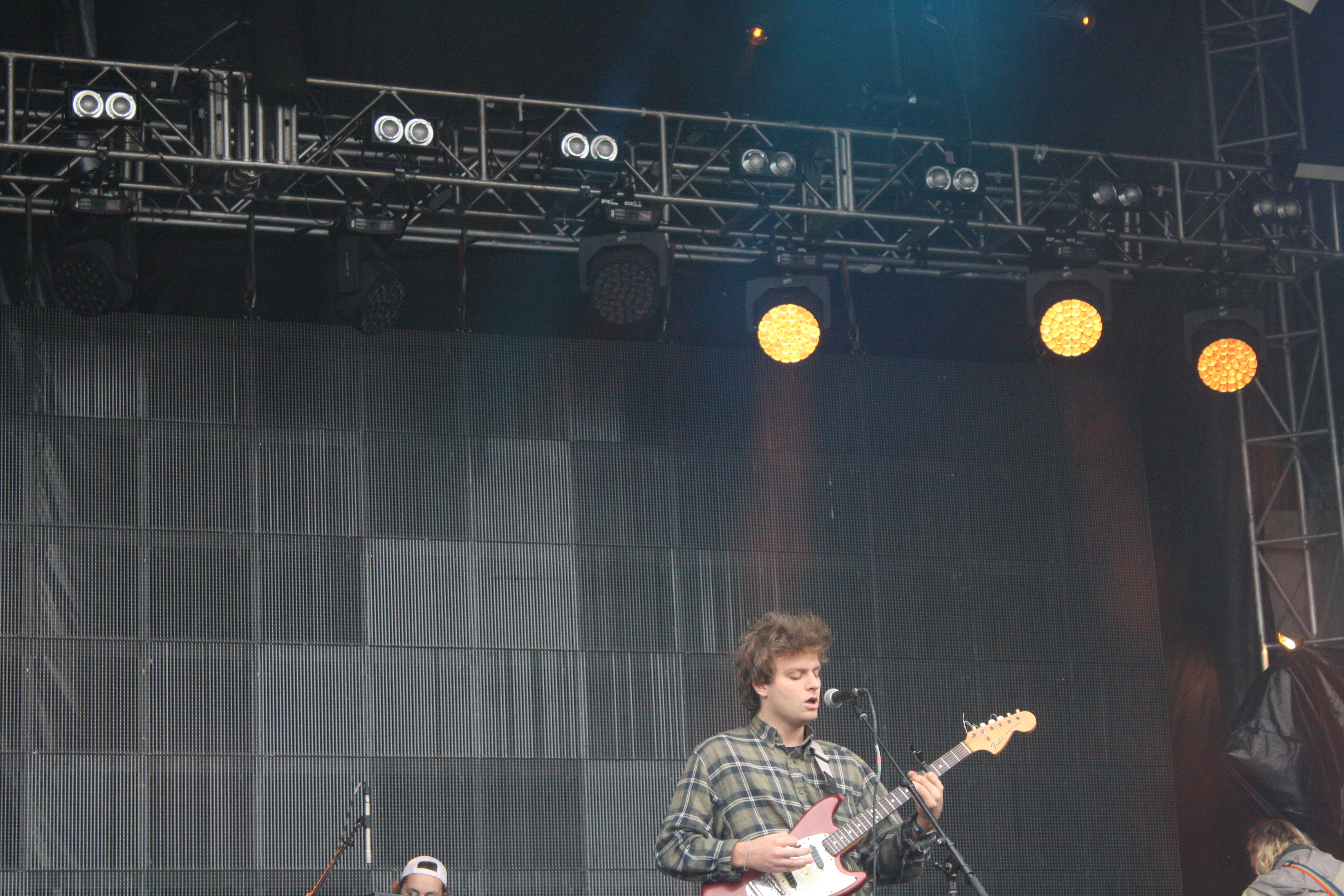
Saturday brought a fair amount of rain and more mud than was appreciated, but that couldn’t stop the party. Mac Demarco’s mid-day set drew one of the most engaged crowds of the whole weekend, with everyone dancing along as he played songs like “Freaking Out the Neighborhood.” He crowdsurfed, he joked, he even pulled up a guy from the crowd and got them to do the guitar solo for his song “Ode to Viceroy,” and he killed it! He then met up with fans at the side of the stage after his set and was all in all a really great guy and a great performer. The night brought out the party animals as big name EDM artists like Major Lazer and Skrillex dominated the late night slots, and Zilker was bathed in neon light and thumping bass.
Mac Demarco at Austin City Limits 2014
Sunday morning brought an early, electrifying performance from Danish songstress MØ, whose solid voice and exciting stage presence made her show all the more memorable. The electronic duo Chromeo gave festival-goers their dose of funk for the weekend, treating the crowd to hits like “Jealous (I Ain’t With It)” and “Fancy Footwork.” The night ended with perhaps what enticed most people to buy a weekend two pass: a breathtaking performance from Lorde. The New Zealand seventeen-year old commanded the stage Sunday night, her incredible voice filling the night air and her spastic yet calculated stage movements capturing the attention of all who watched.
Lorde at Austin City Limits 2014
Though the festival has long been over, the afterglow of those three days still lingers, whether in the form of post-concert depression, the lingering taste of those kimchi fries from Chi’lantro, or the comfort of your commemorative t-shirt. The experience of Austin City Limits is not one that is easily forgotten, but one that is eagerly awaited for as soon as you step foot back home.
Originally posted on Ouch! My Ego on March 7, 2014
Dancing in the Dark: An Interview with George Lewis Jr. of Twin Shadow
The very first time I heard of Twin Shadow was back in my eighth grade year, and it just so happened to be because of one of Urban Outfitters’ LSTN mixtapes — a free monthly compilation of songs that UO published back in 2010 in order to further it’s hipster credentials. Though the mixtapes spanned only 15 volumes and abruptly stopped, my love for Twin Shadow has only grown since I first heard “Slow” through my tinny, pink gummy headphones.
The music of Twin Shadow is incredibly unique: chock-full of dark, groovy guitar riffs with strong R&B undertones and accompanied by Lewis’ amber voice, giving every listener vivid images of lost love and longing through his poetic lyrics. I had the chance to see him for the first time at the 2011 Austin City Limits Festival, and then exactly one year later in McAllen, where I got to meet him and briefly speak with him about his music and his life (shout out to Patrick Garcia for making this happen!). It seems that my story with Twin Shadow is a continued one, as I got the opportunity to speak with him the other day and ask him a couple of questions.
When I called him, he was driving through Los Angeles, where he’s now living. He recently moved to Hollywood from Brooklyn in order to finish polishing up details on the third album, which will no doubt live up to the standards that its predecessors have established. Throughout this morning drive, I got to speak with him about video games, dancing bachata, and Kendrick Lamar.
You visited McAllen the first time in September of 2012, and now you’re back to headline Galax Z Fair III. What made you want to come back?
I always feel like our Texas shows are our best shows. It’s kind of weird, in a way. It was especially nice to go to McAllen and to go to this kind of off-the-beaten path place and have so many people enjoy our music. We always like going to smaller towns to play shows because it’s really worth it.
What’s changed between then and now?
I can’t even remember when we were there. I know we were there, but I don’t remember at what point in Twin Shadow we were there. I know it was after the second record came out, but not too much has changed. I’ve been working on this new record. The band hasn’t been playing out too much. We’ll probably play a couple of new songs while we’re there, maybe two or three. We’ll be testing out all our new material on you guys, and then say to the crowd in Austin that it’s the first time anyone’s heard it. So you all will actually be the first to hear it.
In regards to your new music, do the songs sound anything like “Old Love/New Love”?
It’s kind of interesting. That song is much more dance-y, and so far that hasn’t happened much on the record. But it could change, the record is still not done yet. We’ll see what happens.
“Old Love/New Love” was recorded for Grand Theft Auto V, and you also lent your voice for the radio host of the “Radio Mirror Park” station in the game. How did you become involved with Rockstar Games?
I’ve known those guys for a while now, and we’d always talked about doing something. I’ve kind of become friends with a bunch of those guys over there, and we just talked about doing something together for a long time, whether it was soundtrack work or whatever, and they had the new Grand Theft Auto they were developing, and they reached out to me and were wondering if I wanted to host the radio show and do songs for the soundtrack, and that was it.
Do you play Grand Theft Auto?
Haha! You know, they gave me a copy of the game for the Xbox. I’m one of those people who I’ve always been bad at video games, and I hate being bad at something. I’m really awful at video games; always have been, always will be. I played it a few times. I still haven’t heard my songs playing in the game, so I don’t have that experience yet. I play it time to time, but often times with video games I’ll find myself playing it for a day and then never playing again.
I just recently heard the cover of The Smiths’ “There Is A Light That Never Goes Out” that you did with Samantha Urbani for your UNDER THE CVRS series. Which song did you enjoy recording the most?
Probably my 112 cover of “Cupid”. That was like, my favorite song when I was in high school. That song soundtracked my high school years. That was really cool, and I liked that one the most. But they were all really fun to record, it was fun to record other stuff.
Was one of them more difficult to do than the others?
I mean, reinterpreting a Smiths’ song isn’t easy. I think all of them were kind of a challenge in a way because they’re all really, like, big huge amazing songs. And it’s always pretty easy to fuck up a cover. But it was fun, I didn’t really have to think about it.
What were your high school years like?
Ha, well I didn’t really go to high school. I basically dropped out of high school when I was in my sophomore year. So my high school years were actually pretty exciting. I wasn’t in school, I made a bunch of friends. Well, two of my good friends dropped out kind of alongside with me; they dropped out first and I was like “That’s a good idea!” So I dropped out and I just hung out with a lot of older kids, and it was exciting. I don’t recommend it for everybody, but for me it made a lot of sense to leave high school. A lot of it actually I can credit music to doing that, because when I dropped out I used to hang out this little club called The Blue Parrot, and I met this older guy Zach who really just taught me so much about playing guitar and songwriting. I wouldn’t have had that if I had stayed in school. So I really kind of became a musician by doing that.
My mom was funny [when I dropped out]. Since I was so young, I actually had to get signed out, like officially I had to have my parents sign for me so that I could drop out of high school. My mom actually said to me, “Well, Bill Cosby dropped out of high school, so I guess you can.” So I got the OK. She’s the best.
You were born in the Dominican Republic, and you just recently played a show in Santo Domingo at the Isle of Light Festival. What influence has being Dominican had on your music?
I grew up in America; I was born in Santo Domingo but I really grew up in Florida. I think being a Floridian has more to do with my music than being Dominican at this point. The more I spend time down there and the more I reconnect, the more influence I do think it has. I’m very interested in Dominican music, and I want to learn what I can kind of take from it, because it really is very unique and I’m very drawn to it.
So can you dance merengue? Are you a good dancer?
I can dance merengue and I can dance bachata. My salsa is not so great, though.
As an artist, is fashion and the way you present yourself a big deal to you?
I always say that it’s just like a life thing, I don’t think it has anything to do with being a musician or being in Twin Shadow. I care about presentation in everything.
Do you have any favorite designers or collections?
Right now I’m working closely with this company called the Public School. They’re doing really well; I’m a huge fan of theirs and a huge believer. I just did the music for their runway show [at New York Fashion Week]. They’re amazing. What they do is really inspiring.
Are there any artists or bands that you’re liking at the moment?
I just met up with these guys called Milo Greene, and I’m excited about new things that they’re working on. I’m super excited by Kendrick Lamar. I think he’s gonna save music.
What do you think of the apology text Macklemore sent Kendrick after winning a Grammy?
I don’t think anyone should apologize for winning an award. I mean, awards are such a joke anyways. All that matters is the impact that the music has on people’s lives. It’s nice to win an award, of course. It’s definitely a musician’s dream to win a Grammy because we all grew up thinking, “Oh, that’s the pinnacle of getting the credit you deserve,” I suppose. I think Kendrick’s music has had a much bigger impact in a real way. I know for me, listening to Kendrick’s music, it’s a given to me that he’s probably one of the greatest artists of the last ten years, and he’s just going to continue making amazing music.
Can we expect to see you in the crowd for some of the sets at Galax Z Fair III?
Yeah, for sure! I want to see what’s going on there. I’ve been kind of checked out for a while.
If you take St. Vincent’s discography and play a game of “One of These is Not Like the Other,” you’ll have quite a difficult time, seeing as none of the albums are like one another; each has its own distinct identity. This is what Annie Clark has come to gain praise for: crafting, innovating, and inventing sounds that redefine the very construct of pop, alternative, or whatever genre people choose to place her in, time after time. The truth is that there is no mold to fit the expansive sounds of St. Vincent.
Largely veering away from anything anyone could have expected from her, St. Vincent’s new self-titled manages to retain a very individualistic quality while at the same time taking pages from her past work, bringing forth an album well beyond the 21st century; chock-full of ear-splitting but meticulously constructed guitar riffs and lyrics that are pure poetry, while still colored with the wry humor, lovelorn nostalgia, and passive aggressiveness that St. Vincent is known for.
Songs such as “Digital Witness” and “Huey Newton” serve as the poster children of the album, both carrying an undercurrent of contempt for the technological age of today, while in different forms. The album slows down on “I Prefer Your Love,” a ballad that would presumably get lost among the fervor of riffs in other songs, but is exquisitely carried out and serves almost as a palate cleanser. “Prince Johnny,” a lyrical narrative of a boy looking to be found relevant, is quite honestly the best track on the album, and sounds like it could have been a bonus track on 2012’s Strange Mercy; however, its magnificence would have been lost among the tracks similar to it. Its inclusion on St. Vincent among the gritty riffs of “Birth in Reverse” and “Regret,” and the brilliant insanity of “Bring Me Your Loves” add a completely new dimension not only to the album, but to St. Vincent’s music overall, showing Clark not only as a true master of her craft, but also as a ever-changing, continually powerful musical force.
Originally posted on Ouch! My Ego on February 10, 2014.
Seeing Through Rose-Colored Glasses: An Interview with Frankie Rose
Back when I was an eight-year old, frizzy haired little girl, my dad bought a circular plastic star map, showing all the constellations present in the night sky, complete with labels, and a small chart showing all the constellations of the Northern Hemisphere, as well as where each one will be during a certain month.
Every time we took a trip to the beach, I would pack it into my backpack, along with my armada of Bratz dolls, and at night we would sit in the driveway and stare up into the sky, perhaps searching for the three collinear stars marking Orion’s Belt or for the familiarity that was the Big Dipper. Flash-forward to 2014: the frizzy hair persists, and my love of the stars remains fervent and has turned into looking at the stars for meaning – whether it be in the form of my astrological sign (Scorpio, if you were curious) or perhaps claiming that certain events happen because of the stars.
Surely enough, the stars have aligned and have presented the valley with a beautiful event: Frankie Rose performing at Cine El Rey this Thursday February 13.
A not-so-unfortunate cancellation of all her Pacific Northwest shows and a Valentine’s Day performance in Austin opened up a window for her to come down to McAllen and charm us with her exquisite dream-pop music, something which she has actually been seeking to do for a while. “I’ve heard only amazing things from everyone who’s been going through there,” she says, “I’ve been wanting to go down there forever, but unless you’re already sort of in Texas it doesn’t make huge amounts of sense to get down there.”
I got the chance to speak with Frankie about her Mexican heritage, being a band leader, and if blondes really do have more fun.
I’ve read that you’re of Mexican descent – where in Mexico is your family from?
My family is from Chihuahua, but they are from Texas before Texas was part of the United States, so they’re like Tejanos.
Are there any elements of Mexican culture that you’ve still retained?
I have all my grandma’s recipes – I make Pozole all the time. All that is ingrained in me, and my mom lives in Tijuana. I’m third generation American, I don’t even speak Spanish, or at least not very well so that’s a shame, I wish I did. I definitely relate more to the Mexican side of my Cultural heritage.
I love border towns, that’s why I love Tijuana and Rosarito, I love Mexican culture and I love Mexico. I’ve wanted to do a tour there forever it just, never seemed to work out so this is as close as I’m going to get, but I’ll take it! I’m really excited.
I’m currently in high school and it’s said that the music I listen to now will be what continuously influences me as I get older. What were some of your favorite artists while you were in high school?
The Smiths was the main band, I was obsessed with the Smiths all from when I was twelve and on, up into high school. That was definitely the soundtrack to my adolescence, I would say. That was my number one. The Smiths, The Cure… There are definitely influences from The Cure in my music.
Herein Wild, to me at least when I listened to it, it took on a more serious tone compared to Interstellar. To me Interstellar was like this huge, ethereal, fluid album; it resembled being in a dream, and Herein Wild was sort of waking up from that dream. Was there a certain theme or attitude you wanted to try and convey with this album?
I really like what you just said! I feel like that’s really close to how I felt about making it, actually. Herein Wild is a lot harder-edged, the drums are really present, it’s not sleepy at all, there’s not really any sleepy parts on the album. I really love the analogy you just gave actually; I think it really sums it up. There are a lot of themes actually running through Herein Wild that I don’t think I actually even intended to have. It was a vision of what was happening with me at the time, and even though they’re pop songs and they’re more straightforward and more serious, the lyrics are serious and dark; it’s a dark record, even though it’s poppier.
Was the writing process different compared to your other albums?
With Herein Wild I had four months to turn around an entire record, so it was really different than Interstellar. I wrote songs for Interstellar for like a year before we recorded it and we worked on it in pieces so I had a lot more time to work on that one. So it definitely was a little bit different in terms of the writing process.
I’ve been looking at some pictures of you recently and it hasn’t been too long since you dyed your hair blonde. Do blondes really have more fun?
Haha! I have more fun looking at my pictures. I think if you have black hair, your hair just kind of blends into the background of the photograph, so it’s crazy ‘cause I can actually see what my hair looks like for once! That’s kind of fun. So yeah, I guess blondes do have more fun.
I’ve also noticed that you’ve got some really cool tattoos on your arms! I’m a big fan of the significance that tattoos hold – do yours mean anything in particular?
You know it’s so funny, I forget. I got all my tattoos when I was really young, so now I forget that I have them. If I could go back I probably would not have done it at all. It’s sort of the first thing people notice about you when they see you, which is why I would tell anybody not to get a tattoo. You don’t want to be defined by a tattoo. It’s just some scribbles on my arm and none of them really mean anything!
You’re a former member of Crystal Stilts, Dum Dum Girls, and Vivian Girls. Is there something that you took from being in these bands that found itself into your solo work? Maybe things you picked up from other members?
Each one was a really great learning experience for me, sometimes positive and sometimes negative. I definitely took away things from each band. For example, JB of Crystal Stilts is an amazing guitar player and I learned so much from him. I learned how to run a band, how to be a band leader, I learned what things I didn’t want to do, how I didn’t want to run a band. Just sonically I absorbed something from all the bands, what it is exactly I couldn’t tell you. From record to record you learn more and your style changes.
Would you say you prefer working with yourself being the band leader as opposed to being in a band?
I really do like working alone. I like working with a producer though, because I really do like having someone to bounce my ideas off of, and there’s a lot of things that I’m not particularly skilled at, like I’ll hear something – a synth I want or something, I’m not the most amazing synth wizard in the world – so it’s nice to have someone around to help shape the ideas, like the production ideas that I have, because that’s my strong point. I’m not a great musician, I just think that I have ideas, and I want to see them manifested. And that is the most gratifying thing, to have your sort of vision realized.
You currently live in Brooklyn, and countless bands make a sort of “pilgrimage” to Brooklyn, you know, and they start themselves up and become these Brooklyn-esque bands. How has living in Brooklyn inspired you?
I don’t think that I’m specifically influenced; in fact, I think being in Brooklyn is detrimental to me because there’s no space. I really don’t go outside for inspiration. It’s purely internal for me. You could pretty much lock me in a room, and I would find all I need in there. I could be anywhere.
Your show in McAllen is the night before Valentine’s Day. I have to ask – are you the romantic type?
No, I’m really not. It’s terrible but I’m not. I’ll go out to dinner with friends but not a big thing. I don’t like big productions.







 Isabella R. Soto